Every construction site carries inherent risks. No matter how experienced the crew, one lapse in judgment or overlooked hazard can lead to injury, downtime, or worse. Yet many safety incidents are preventable—starting with a five-minute conversation. Toolbox talks bridge the gap between policy and practice, turning broad safety rules into real-world vigilance.
These short, focused discussions aren’t just procedural checkboxes. When done right, they reinforce awareness, clarify expectations, and save lives. The key? Choosing the right topics—those that address immediate risks, adapt to changing site conditions, and resonate with workers on the ground.
Below are the most impactful construction safety toolbox talk topics, each grounded in real hazards, regulatory standards, and frontline experience.
Why Toolbox Talks Matter More Than Ever
Construction remains one of the most dangerous industries. According to OSHA, falls, struck-by incidents, electrocutions, and caught-in/between hazards account for the “Fatal Four”—responsible for nearly 60% of construction worker deaths annually.
Toolbox talks cut through complacency. They’re not meant to replace formal training but to reinforce it—especially when conditions shift. A sudden rainstorm increases slip risk. A new crane delivery introduces new blind spots. Temporary scaffolding brings fall exposure.
These micro-sessions work best when timely, specific, and interactive. A generic “stay safe” speech won’t stick. But a 10-minute discussion on how to adjust fall protection when working near roof edges during high winds? That sticks.
Top 8 High-Impact Toolbox Talk Topics
#### 1. Fall Protection – The Leading Killer on Site
Falls are the number one cause of construction fatalities. Yet many workers still bypass harnesses, ignore guardrails, or assume “I’ve done this before” applies.
Use this talk to: - Review proper use of personal fall arrest systems (PFAS) - Demonstrate correct anchor point selection - Discuss edge protection on leading edges - Address housekeeping (debris on platforms increases slip risk)
Real-world example: A roofer stepped back to adjust a bundle and fell 18 feet because the warning line was 5 feet from the edge—below OSHA’s 6-foot requirement. A quick pre-shift check, prompted by a toolbox talk, could have caught it.
Common mistake: Assuming fall protection isn’t needed for short durations. OSHA doesn’t grant time-based exceptions.
#### 2. Electrical Safety – Respect the Current
From overhead lines to temporary wiring, electrical hazards are everywhere. The danger isn’t always visible—faulty grounding or damaged insulation can be silent killers.
Focus on: - Identifying overhead power lines (minimum 10-foot clearance) - Lockout/tagout (LOTO) procedures before servicing equipment - Using GFCI protection on all 120V outlets - Recognizing warning signs: frayed cords, warm tools, tripped breakers
Use case: A worker plugged a damaged extension cord into a power tool. The exposed wire energized the metal housing, resulting in a severe shock. A 5-minute inspection, discussed in a prior toolbox talk, would’ve flagged the hazard.
#### 3. Struck-By and Struck-Against Hazards
Moving equipment, swinging loads, flying debris—these are constant threats in dynamic environments.
Key points to cover: - Spotter roles during crane or backhoe operations - High-visibility clothing requirements - Safe distances from operating machinery - Securing tools at height to prevent drop hazards
Limitation: Not all workers understand hand signals. Reinforce standardized communication methods during equipment operation talks.
Workflow tip: Conduct this talk after any near-miss involving vehicles—timing amplifies relevance.
#### 4. Confined Space Awareness
Even if your site doesn’t have tanks or vaults, temporary confined spaces form during construction—deep excavations, utility trenches, or enclosed structural steel frames.
Talk must include: - Definition of a confined space (limited entry/exit, not designed for occupancy) - Atmospheric testing before entry - Rescue plan—no entry without one - Permit requirements for permit-required confined spaces
Critical mistake: Sending in a rescuer without gear when someone collapses. Asphyxiation claims would-be heroes too. Emphasize “call, don’t rush.”
#### 5. Hazard Communication and Chemical Safety
Jobsites use adhesives, solvents, paints, and cleaning agents—many with flammable, toxic, or reactive properties.
Ensure workers know: - How to read Safety Data Sheets (SDS) - Proper PPE for each chemical (gloves, respirators, goggles) - Storage requirements (separate flammables, ventilate areas) - Spill response procedures
Practical tip: Keep SDS binders or digital access on-site. During the talk, pull up one commonly used product and walk through its hazards.
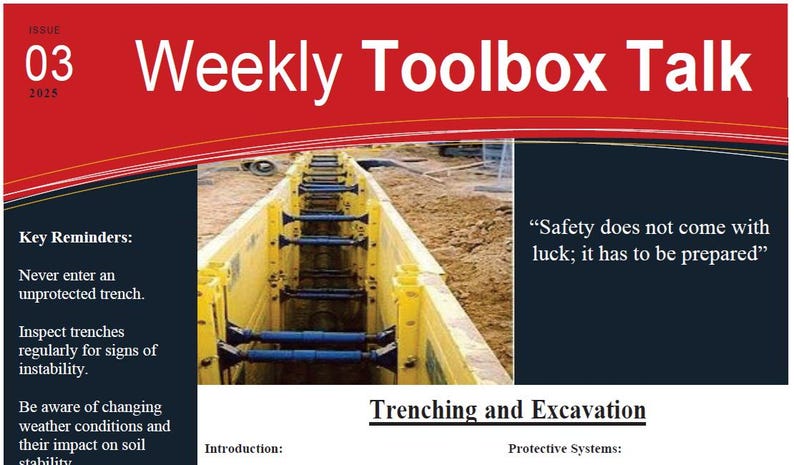
#### 6. Excavation and Trenching Safety
Cave-ins kill quickly. A cubic yard of soil weighs over 3,000 pounds—enough to crush or suffocate.
Essential discussion points: - Soil classification (Type A, B, C) and its impact on protection - Required protective systems: shoring, shielding, sloping - Daily inspection by a competent person - No workers in trenches deeper than 5 feet without protection
Realistic scenario: A utility crew began digging without a trench box because “it’s only 6 feet.” Soil shifted after rain, leading to a partial collapse. A toolbox talk linking weather and soil stability could have prevented it.
#### 7. PPE Beyond the Basics
Hard hats and steel-toes are standard, but many overlook task-specific protection.
Cover: - Hearing protection in high-noise zones (85 dB+) - Respirators for dust, fumes, or mold - Cut-resistant gloves for handling rebar or sheet metal - Face shields during grinding or welding
Common pitfall: Wearing PPE incorrectly. A hard hat worn backwards may not meet ANSI standards. Use the talk to inspect gear with the crew.
#### 8. Heat and Cold Stress Prevention
Weather-related illness is preventable but often ignored until it’s too late.
In summer: - Recognize signs of heat exhaustion (dizziness, nausea, cool skin) - Encourage water breaks every 15–20 minutes - Schedule heavy tasks for cooler hours
In winter: - Watch for numbness, shivering, confusion (hypothermia) - Layer clothing; avoid cotton next to skin - Keep dry—wet insulation loses effectiveness
Pro tip: Assign a "buddy system" during extreme weather. Workers monitor each other for early symptoms.
How to Run an Effective Toolbox Talk
A good talk isn’t a lecture—it’s a dialogue. Follow this workflow:
- Choose the Topic Based on Conditions
- Not every talk needs to rotate through a list. If it rained overnight, lead with slips and fall risks. If a new crane arrived, focus on lift zones.
- Keep It Brief (5–10 Minutes)
- Attention spans are short. Stick to one hazard. Use visuals: bring a damaged harness or hold up a cracked hard hat.

- Engage the Crew
- Ask: “Have you seen this happen?” or “What would you do if…?” Real stories stick.
- Document Attendance
- Sign-in sheets prove compliance during audits. Include date, topic, supervisor, and names.
- Act on Feedback
- If workers report a recurring issue—say, blocked egress routes—address it immediately. Follow-up builds trust.
What fails: Reading from a printed script without eye contact. Workers tune out.
What works: Standing in the middle of the crew, asking questions, using local examples.
When to Customize Your Topic
Standard topics are essential, but customization drives relevance. Consider:
- Project Phase: Foundation work? Focus on excavation. Interior fit-out? Highlight ladder safety and dust control.
- New Equipment: Introduce safety protocols before rollout.
- Near-Misses: Turn incidents into learning moments—without blaming.
- Seasonal Shifts: Snow removal, monsoon prep, summer heat plans.
A talk on ladder safety before drywall installation—when every crew is on a step ladder—lands far better than one delivered randomly in January.
Common Mistakes That Undermine Safety Talks
Even well-intentioned sessions fall short when:
- Topics are recycled too quickly – Repetition without variation breeds disengagement.
- Supervisors don’t participate – If the foreman checks his phone, so will the crew.
- No follow-up actions – Identifying a tripping hazard but not fixing it destroys credibility.
- Only covering one type of risk – Overemphasizing falls while ignoring chemical exposure creates blind spots.
- Ignoring worker input – Frontline workers often see risks before management.
Fix these by rotating facilitators, acting on reported issues, and integrating feedback into future talks.
Make Safety Part of the Culture
The best toolbox talks don’t just inform—they influence behavior. They turn safety from a compliance requirement into a shared value.
When workers start reminding each other to tie off or clean up spills, the culture has shifted. That doesn’t happen from posters or policies alone. It happens when consistent, credible conversations make safety personal.
Use these topics as your foundation. Adapt them. Measure their impact. And never treat them as a box to check.
Start tomorrow’s shift with a focused, five-minute talk on today’s biggest risk. That’s how you build a safer site—one conversation at a time.
FAQ
What are the most common toolbox talk topics in construction? Fall protection, electrical safety, PPE, excavation, struck-by hazards, hazard communication, confined spaces, and weather-related risks are the most frequent and critical topics.
How often should toolbox talks be held? Weekly is standard, but high-risk activities or changing conditions may require daily talks. OSHA recommends regular, documented discussions.
Who should lead a toolbox talk? A competent person—typically a supervisor or safety officer—should lead, but crew members can facilitate with proper preparation.
Do toolbox talks need to be documented? Yes. Attendance records help demonstrate compliance during inspections and audits.
Can toolbox talks reduce workplace incidents? Yes. Studies show sites with consistent safety talks report fewer near-misses and lower injury rates due to heightened awareness.
Should toolbox talks be the same every week? No. Rotate topics and tailor them to current operations, weather, equipment, and project phase to maintain relevance.
How long should a construction toolbox talk last? Ideally 5 to 10 minutes—long enough to cover the hazard, short enough to hold attention.
FAQ
What should you look for in Essential Construction Safety Toolbox Talk Topics for 2024? Focus on relevance, practical value, and how well the solution matches real user intent.
Is Essential Construction Safety Toolbox Talk Topics for 2024 suitable for beginners? That depends on the workflow, but a clear step-by-step approach usually makes it easier to start.
How do you compare options around Essential Construction Safety Toolbox Talk Topics for 2024? Compare features, trust signals, limitations, pricing, and ease of implementation.
What mistakes should you avoid? Avoid generic choices, weak validation, and decisions based only on marketing claims.
What is the next best step? Shortlist the most relevant options, validate them quickly, and refine from real-world results.


